
Belong or Break
Dr Donna Lyon of Left Write Hook as part of the Global Impact Summit

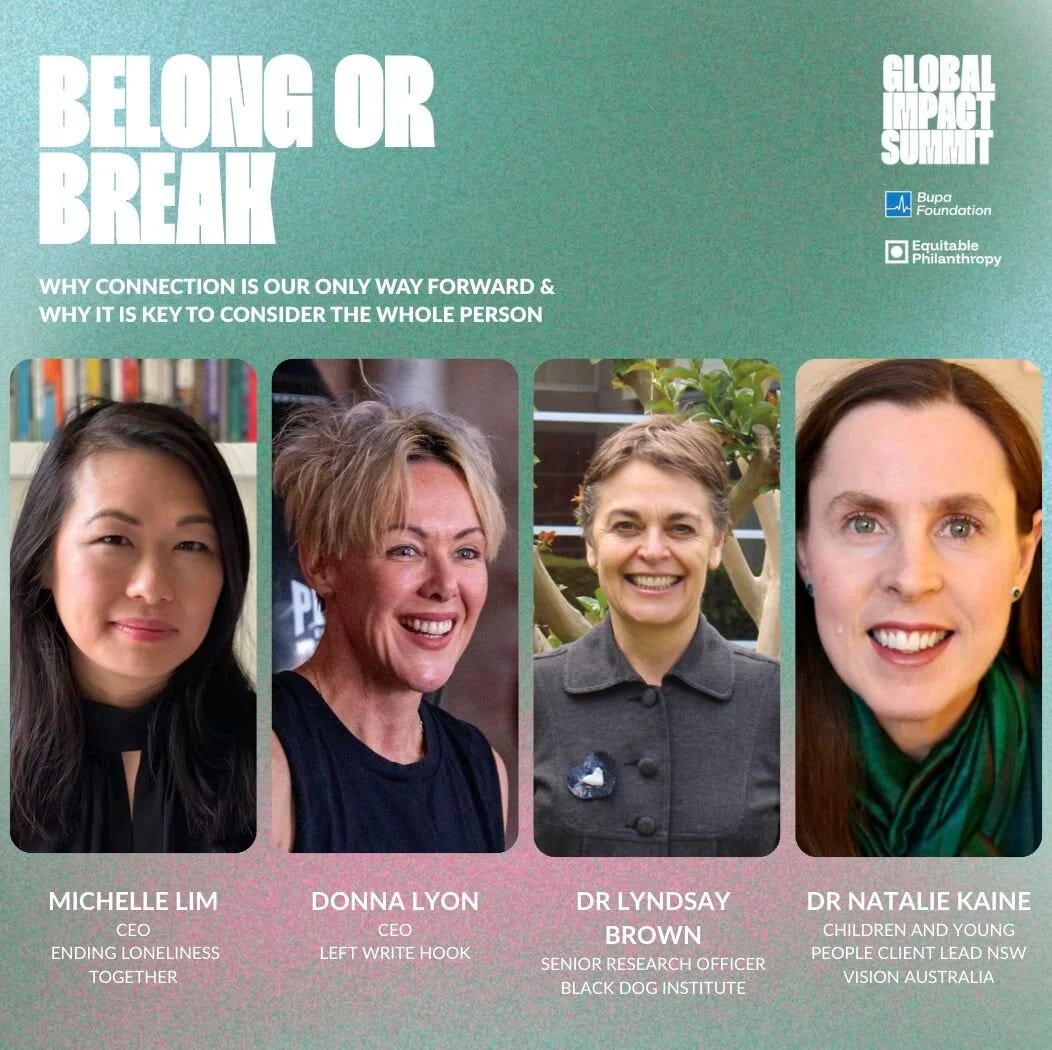
Did you miss out on the Global Impact Summit? Or perhaps just our stream on Global Health? Well don’t worry, we are collating a collection of the speakers insights and presentations that we have had permission to share beyond the day.
In this session, Dr Donna Lyon spoke as part of Belong or Break, a session within The Future of Global Health Impact, the stream Equitable Philanthropy curated in partnership with the Bupa Foundation at the Global Impact Summit on 6 August 2026.
The stream as a whole was built around a single question: what actually creates healthier societies and how do we scale it, treating health not as a matter of medicine alone but as a systems challenge spanning prevention, access and equity, research and innovation, funding and healthy ageing.
Belong or Break was conceived as a deliberate counterweight to that systems framing. Where much of the day dealt in strategy and data, this session brought together five speakers, each drawn from organisations working at the frontline of trauma, loneliness and ill health, and asked them to return the room to the individual behind the figures.
Each speaker was asked to answer three questions in their own way and through their own work:
why lived experience matters
why connection is our only way forward, and
why any meaningful response to global health has to consider the whole person, not just the condition being treated.
The brief for the session was explicit that this should be the most human and most moving segment of the program, delivered without slides, in under five minutes, built around a single specific story rather than a run of statistics.
Dr Lyon spoke in this context as founder of Left Write Hook, the Australian program that combines boxing and creative writing to support survivors of trauma and abuse, work grounded in the same conviction the session was built to test, that belonging may be one of the most powerful forms of prevention available to us.
But one of the reasons this was a stand-out for me is because Donna questioned our proposition, and posed a series of questions back on us.
Here’s Donna’s speech, published with permission (thank you for sharing Donna!):
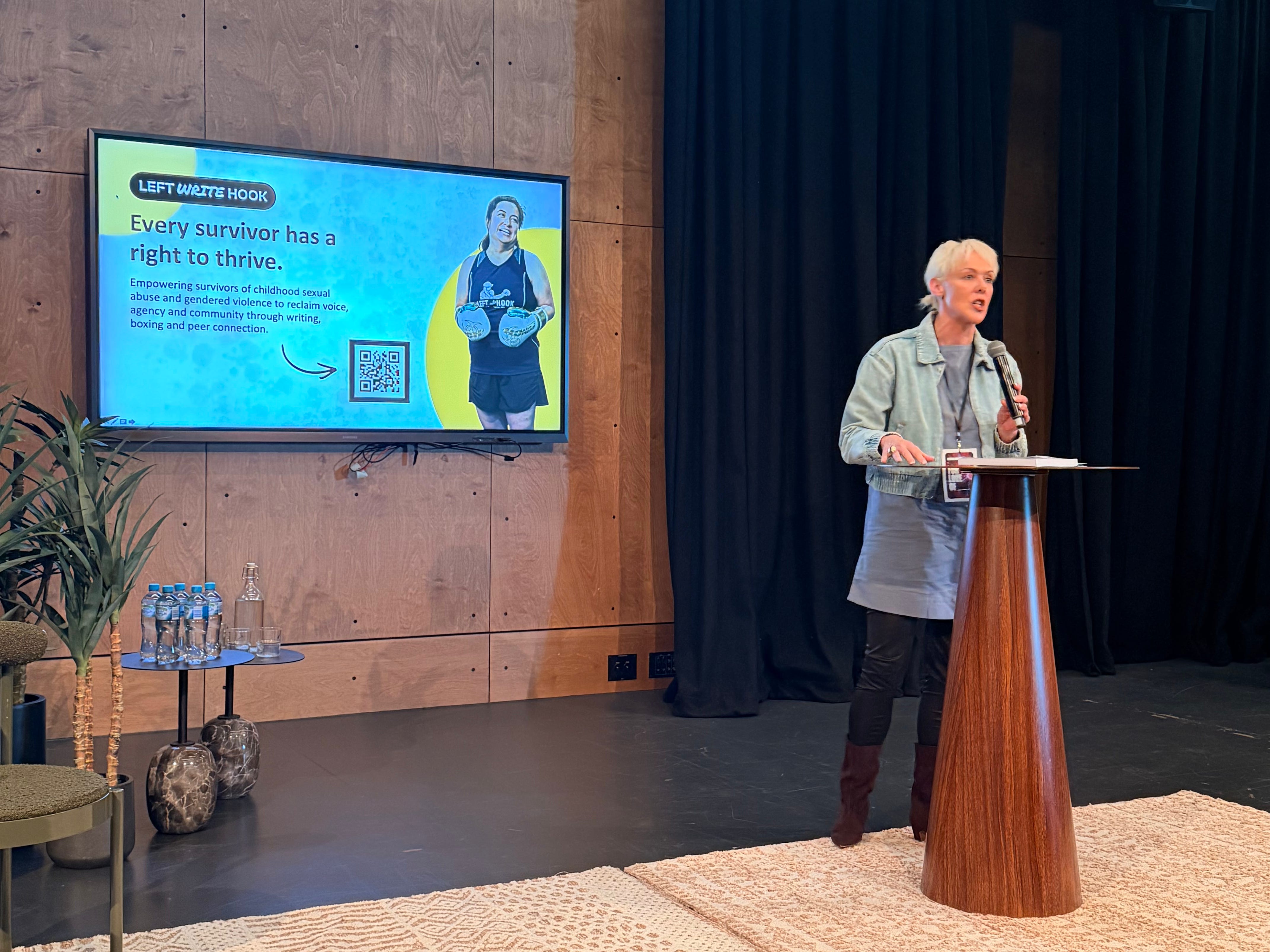
“My talk today is about the double bind of connection: the thing we may need most can also be the thing that feels least safe for some.
I’m Dr Donna Lyon, founder and CEO of Left Write Hook, a survivor-led charity supporting adult survivors of childhood sexual abuse and gendered violence through creative writing, non-contact boxing and peer connection.
I’m also a survivor and before Left Write Hook became an organisation, it really began as something I was trying to understand in my own body: why I wanted connection so deeply, and why connection could also feel terrifying.
I once wrote:
“I connected and I disconnected. I fell down a black hole, a spiral of darkness. It felt safe. I found out later it was dissociation.
I connected and I laughed as though it was the most freeing experience.
I connected and I broke down. I shivered and shook.
I connected and I ran.
To connect is to get hurt. A paradox because to connect is what I desire, is what I need to feel and move on, yet I sit scared in the corner, looking out through a long lens telescope, eyeing the situation.”
That writing later appeared in the Left Write Hook book and documentary (check it out on Netflix) , alongside the stories of other survivors who took part in our first creative arts writing and boxing project.
For many survivors, like me, the idea of connection is not simple.
Research says healing is relational, and I believe that deeply. But we need to be careful not to turn connection into another demand placed upon people who have already survived so much.
Connection may be what we need, but it may not yet feel possible.
For someone whose trust has been profoundly violated, being seen can feel dangerous. Being in a room with others can activate shame, fear, dissociation, bodily memories, or the urge to run.
Sometimes disconnection is not failure. It may be the very strategy that kept a person alive.
This is one of the reasons lived experience matters in health and wellbeing organisations. People with lived experience can often recognise behaviours that systems might misread as disengagement, resistance or failure.
So at Left Write Hook, we do not force connection.
We try to create the conditions for connection that is safe enough.
In our 8-week program participants write, they reflect, then they learn the art of boxing as a movement of strength and empowerment.
Some participants connect through words and others connect first through punching a bag.
Connection often happens when they hear another person say something they thought only they had felt or experienced.
Some survivors connect by returning the following week, even though every part of them wanted to isolate and stay home.
Trauma does not live only in language. It can live in posture, breath, muscle tension, silence, memory, movement and our relationships.
So the work we do brings together mind, body, story and community.
The writing gives shape to what may have felt unspeakable. The boxing offers movement, agency and the experience of taking up space. And the group offers recognition: the experience of being witnessed without having to pretend that recovery is simple.
Our work is led by lived experience because survivors need to be seen more than as a consumer. They need to experience themselves as people with knowledge, agency, creativity and something valuable to offer.
So connection is our way forward, but it’s not connection at any cost, it has to be with choice, dignity and without judgement about what it looks or feels like.
Working with survivors means understanding the paradox of connection -that someone may reach towards you and pull away at the same time.
It took years for me to find connection through writing, boxing, and safely sharing the impact of my experiences.
But that did not stop me from showing up, making an award-winning documentary and building a research-informed charity led by survivors.
Connection may already be there, even when it is not yet integrated, fully realised or embodied.
The process of discovering connection is part of the connection itself.
My invitation to this room is simple.
Our task is not to expect people to simply connect.
Our task is to create the conditions in which we can discover, together, what connection might make possible. Thank you.”